
CIANOTIPIA
Durante este fim de semana fiz alguns testes de cianotipia com vários vestidos de bonecas. O objectivo final será fazer com alguns vestidos fornecidos pelo Coliseu de Lisboa. Esta técnica de impressão analógica, inventada em 1842, é sensível à luz solar e caracteriza-se pela sua cor azul (cian). A imagem é criada colocando objectos (neste caso, coloquei os vestidos de bonecas) sobre o papel preparado com os reagentes químicos e expondo-o à luz solar.
This weekend I did some cyanotype experiments using various dolls’ dresses. The final goal will be to work with some dresses provided by the Coliseu de Lisboa. This analogue printing technique, discovered in 1842, is sensitive to sunlight and is characterised by its blue (cyan) colour. The image is created by placing objects (in this case, I placed the dolls’ dresses) on paper coated with chemical solutions and exposing it to sunlight.
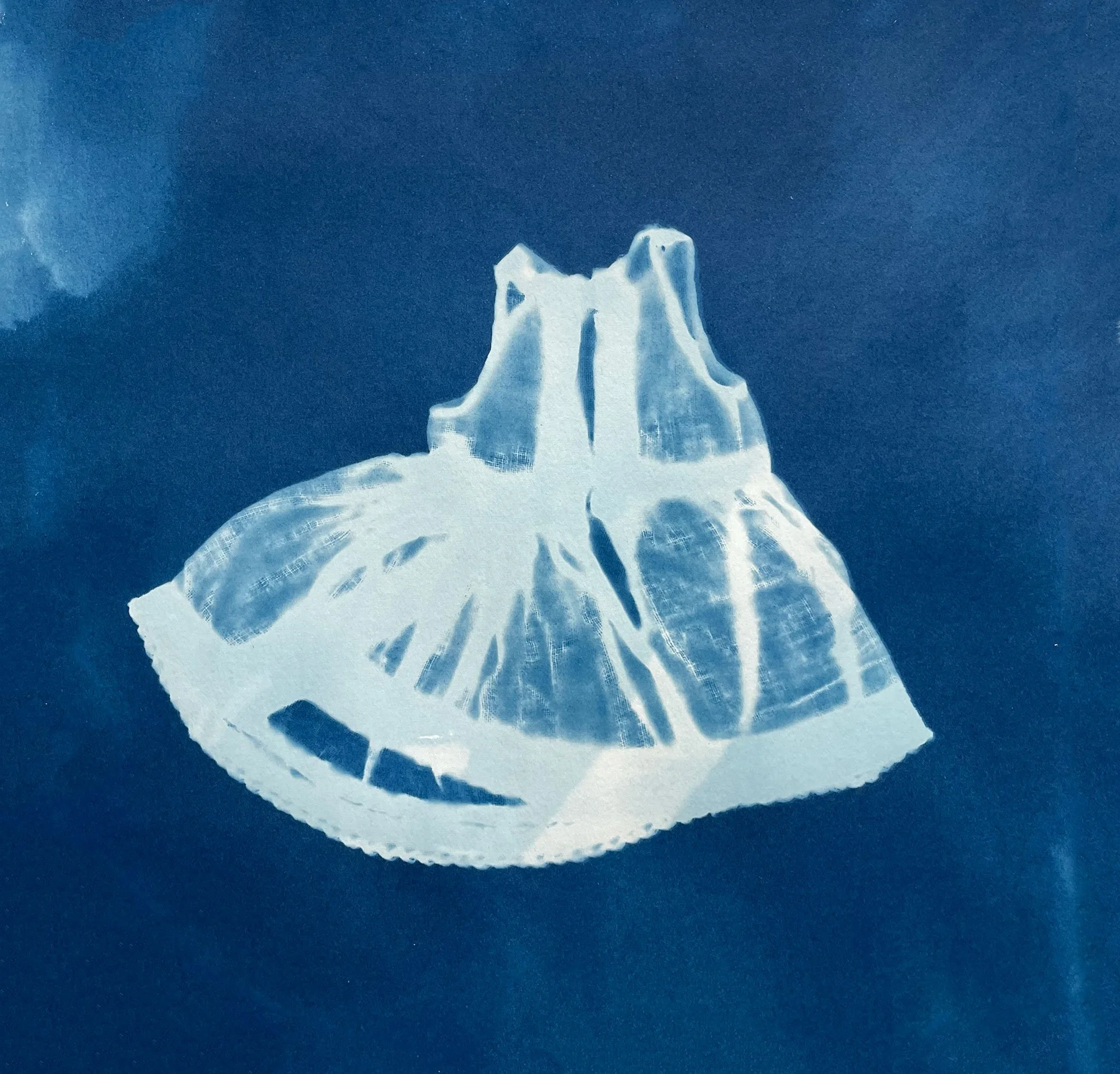
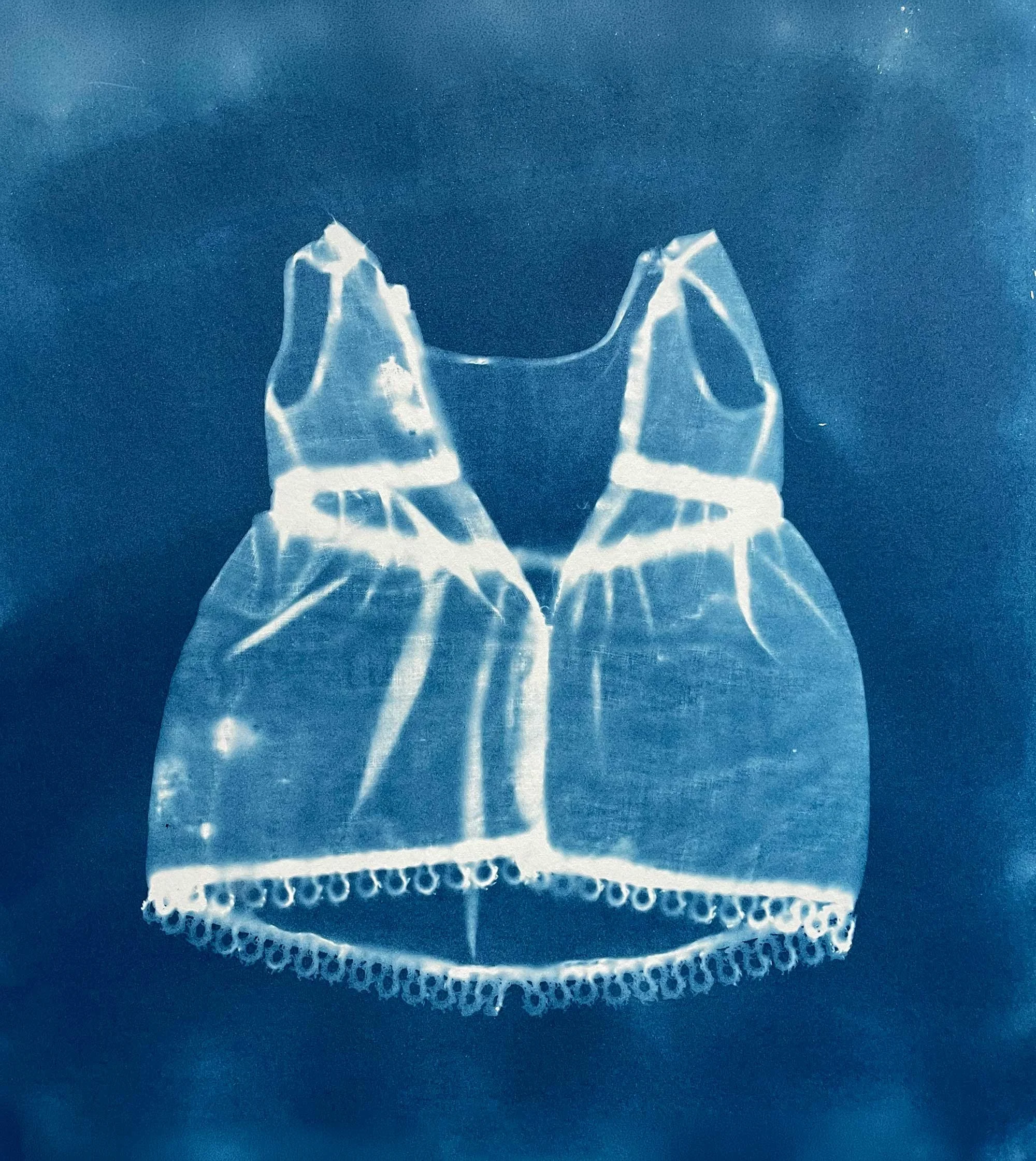
Tal como na cianotipia, em que a imagem dos vestidos — mais uma vez, a roupa como segunda pele — é revelada pela ação da luz solar, também a nossa pele reage e se transforma com essa mesma exposição. O sol, ao longo do tempo, “imprime” marcas no corpo, contribuindo para o envelhecimento e o aparecimento de rugas. Foi precisamente essa relação entre luz, revelação e transformação que me inclinou a escolher a cianotipia para este trabalho.
De forma semelhante, o uso de corantes azuis na histologia, como no caso do AFOG, permite evidenciar estruturas como o colagénio, tornando visível as camadas mais profundas da pele. Assim, neste caso, tanto na prática artística como na ciência, a cor azul surge como meio de revelar tanto a forma exterior, como a estrutura interna.
Just as in cyanotype, where the image of the garments — once again, clothing as a second skin — is revealed through the action of sunlight, our own skin also reacts and transforms with that same exposure. Over time, the sun “prints” marks onto the body, contributing to ageing and the appearance of wrinkles. It was precisely this relationship between light, revelation, and transformation that led me to choose cyanotype as the technique for this work.
Similarly, the use of blue dyes in histology, as in the case of AFOG, allows you to highlight structures such as collagen, rendering the deeper layers of the skin visible. Thus, in this case, the colour blue serves as a means of revealing both external form and internal structure.
